Corrugated Perforated Aluminum Sheet
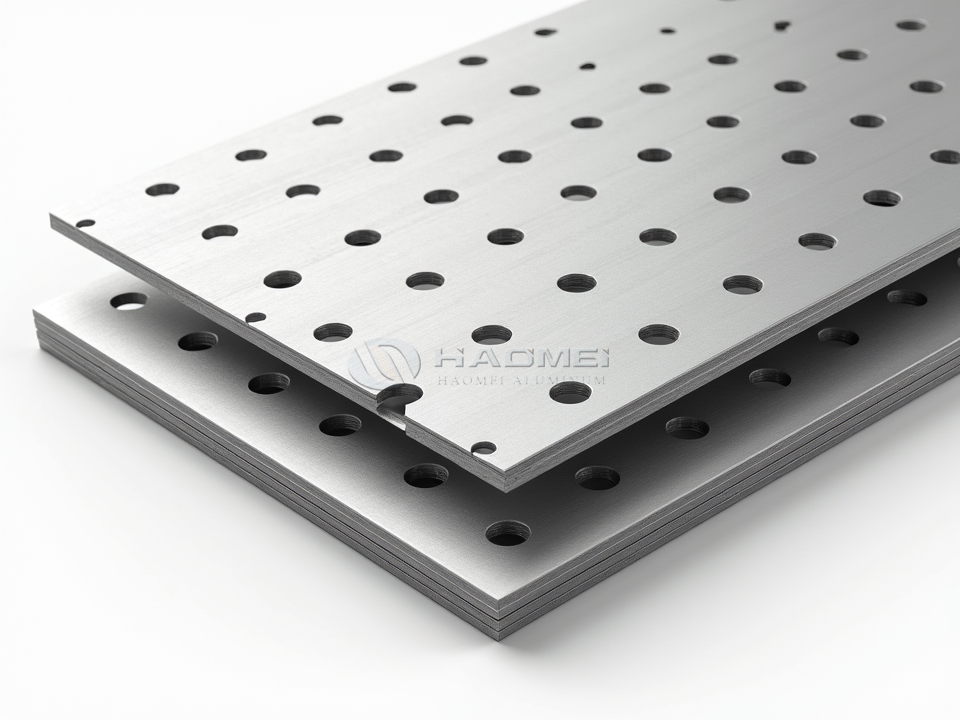
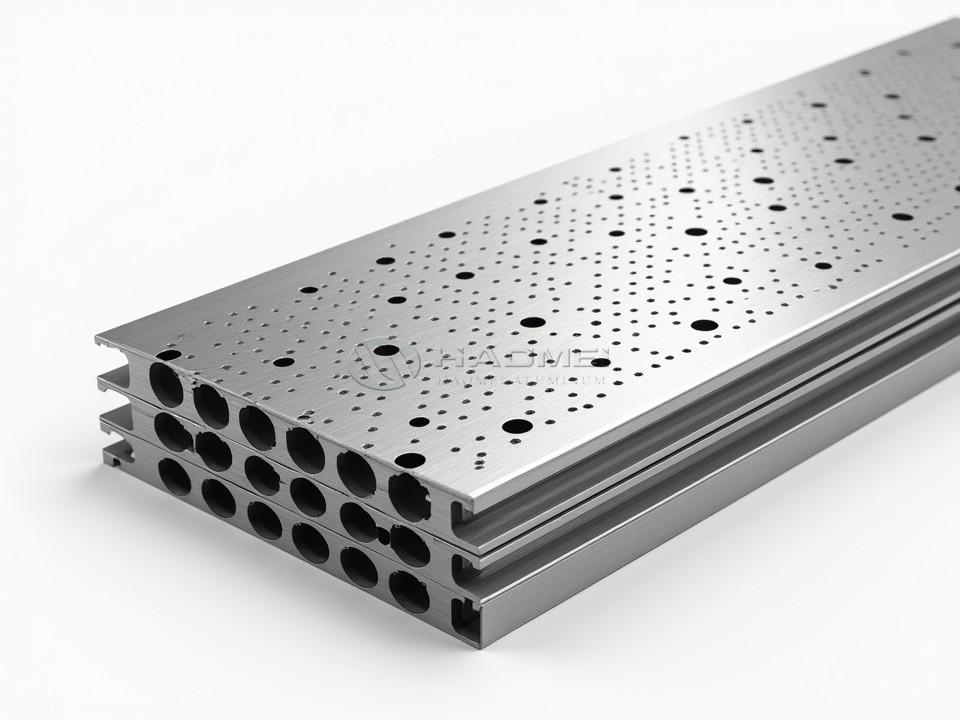
Corrugated perforated aluminum sheet combines formed ribs with precision-punched openings in one lightweight metal panel. The corrugated profile increases stiffness, while the perforations provide controlled airflow, light transmission, drainage, and visual depth. This combination makes the material an effective choice for architectural cladding, sun screens, acoustic systems, protective guards, equipment covers, and decorative interiors.
Unlike a flat perforated panel, a corrugated perforated aluminum sheet resists bending more effectively across its formed direction. It can therefore cover wider spans with less supporting structure in many applications. Aluminum also offers natural corrosion resistance, low weight, high recyclability, and broad finishing possibilities, including mill finish, anodizing, PVDF coating, powder coating, and wood-grain transfer finishes.
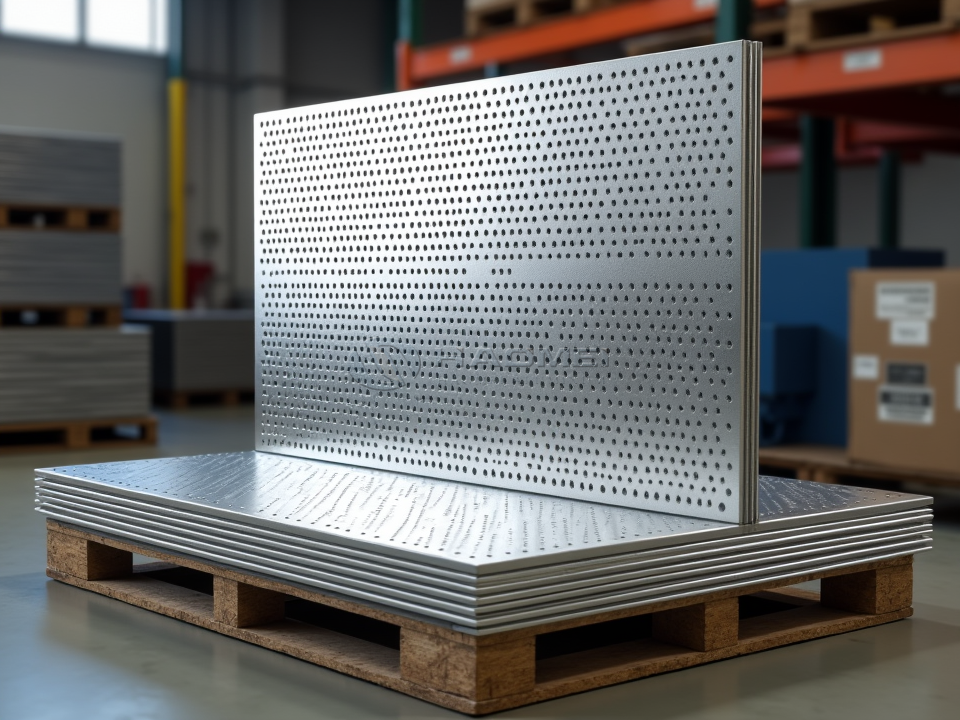
Product Characteristics
| Property | Customer Benefit |
|---|---|
| Corrugated profile | Improves rigidity and creates a dimensional architectural appearance |
| Perforated surface | Supports ventilation, daylight control, drainage, and acoustic absorption |
| Low density | Simplifies handling, installation, and supporting-frame design |
| Corrosion resistance | Performs reliably in humid, urban, and many coastal environments when properly finished |
| Flexible patterns | Round, square, slotted, hexagonal, and custom perforations are available |
| Decorative finish options | Supports color matching for facades, ceilings, partitions, and equipment enclosures |
| Recyclable aluminum | Supports circular material use and reduced end-of-life waste |
The corrugation pitch, rib height, sheet thickness, perforation pattern, and open-area ratio should be selected as a system. Deep corrugations improve panel stiffness but may influence punching layout and visual transparency. Large openings increase airflow and reduce weight, yet they also lower the remaining metal section. A balanced design delivers the required appearance without sacrificing fabrication stability.
Common Applications
| Application | Typical Function | Recommended Design Focus |
|---|---|---|
| Building facades | Ventilated rainscreen, visual screening, solar shading | Weather-resistant coating, consistent color, controlled open area |
| Exterior louvers | Air intake and equipment concealment | Slotted or round holes, drainage paths, corrosion protection |
| Ceiling systems | Decorative ceiling skin and return-air panel | Lightweight gauge, acoustic backing, clean perforation edges |
| Acoustic wall panels | Sound absorption when combined with insulation | Open area, acoustic fleece, cavity depth, hole diameter |
| Balcony and stair screens | Privacy barrier with airflow and light | Anti-climb pattern, rigid corrugation, safe folded edges |
| Machinery covers | Guarding and ventilation around industrial equipment | Structural strength, hole size, maintenance access |
| Agricultural and transport panels | Ventilation and lightweight enclosure | Impact resistance, corrosion resistance, easy cleaning |
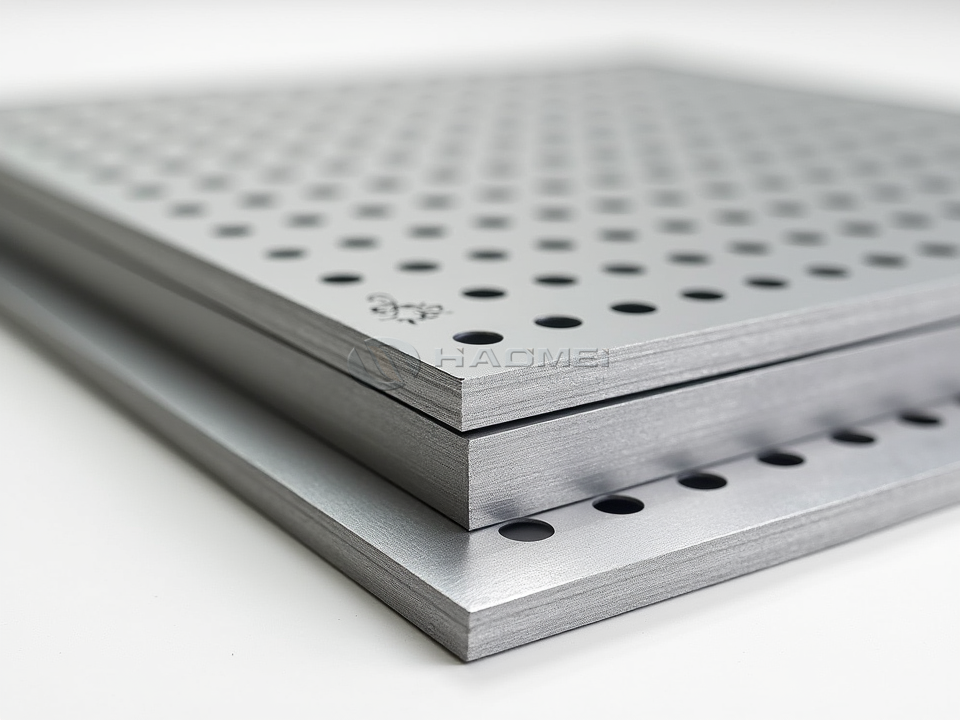
For projects requiring a flatter visual plane or a different hole geometry, a Perforated Aluminum Plate may be selected alongside corrugated panels for matching trims, doors, or interior features.
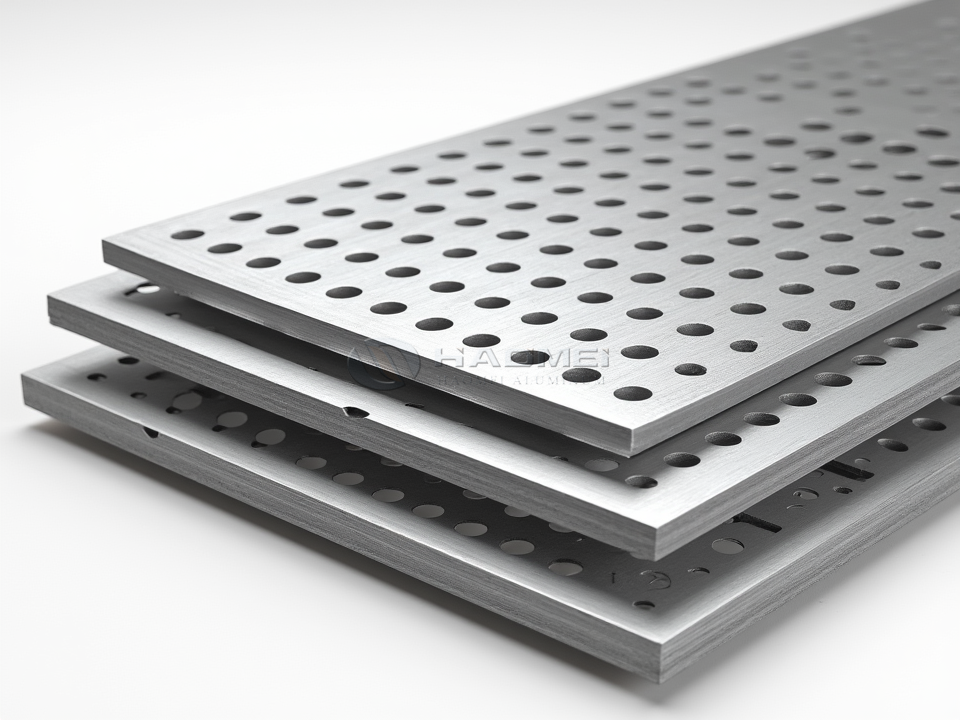
Typical Technical Specifications
| Parameter | Standard Range | Custom Capability |
|---|---|---|
| Alloy | 1050, 1060, 1100, 3003, 3004, 5052 | Alloy selection based on forming and corrosion requirements |
| Temper | O, H14, H16, H18, H24, H32 | Matched to forming depth and required stiffness |
| Base thickness | 0.5-3.0 mm | Heavier gauges available for industrial panels |
| Panel width | 300-1,500 mm | Cut-to-width production available |
| Panel length | 500-6,000 mm | Longer lengths subject to handling and transport limits |
| Corrugation height | 5-50 mm | Profile tooling can be developed for volume orders |
| Corrugation pitch | 25-250 mm | Designed around aesthetic and load requirements |
| Hole diameter | 1.0-20.0 mm | Micro-perforation and larger custom holes available |
| Open area | 10%-60% | Determined by hole size, pitch, and pattern |
| Edge treatment | Sheared, hemmed, folded, framed | CNC cutting and formed edges available |
| Surface finish | Mill, brushed, anodized, powder coated, PVDF | RAL colors and project-specific finishes available |
Actual dimensional tolerances depend on sheet thickness, corrugation geometry, perforation density, and finishing route. Perforating before corrugation is common, although the processing sequence can be adjusted to manage distortion, preserve hole shape, or achieve a particular decorative result.
Alloy and Temper Selection
| Alloy | Suitable Tempers | Performance Characteristics | Typical Use |
|---|---|---|---|
| 1050 / 1060 | O, H14, H18 | Excellent formability and conductivity; moderate strength | Interior panels, ceilings, decorative screens |
| 1100 | O, H14, H16 | Good corrosion resistance and workability | General-purpose perforated panels |
| 3003 | H14, H16, H24 | Better strength than 1xxx alloys; good forming behavior | Corrugated cladding, equipment covers, roofing details |
| 3004 | H24, H34 | Higher strength with good corrosion resistance | Larger architectural panels and formed components |
| 5052 | H32, H34 | Strong marine corrosion resistance and fatigue performance | Coastal screens, transport panels, industrial enclosures |
3003-H24 is often a practical choice for architectural corrugated perforated aluminum sheet because it offers an effective balance of formability, rigidity, and surface quality. For salt-laden or chemically demanding environments, 5052-H32 is frequently preferred. Soft O temper is suitable where deep forming is needed, but it may require closer support spacing after installation.
Chemical Composition
Chemical values are shown as typical maximum limits in percent by mass, except where a range is stated. Material certification should be confirmed against the applicable ASTM, EN, JIS, or customer specification.
| Alloy | Si | Fe | Cu | Mn | Mg | Cr | Zn | Al |
|---|---|---|---|---|---|---|---|---|
| 1050 | 0.25 | 0.40 | 0.05 | 0.05 | 0.05 | - | 0.05 | 99.50 min |
| 1060 | 0.25 | 0.35 | 0.05 | 0.03 | 0.03 | - | 0.05 | 99.60 min |
| 1100 | 0.95 Si + Fe | - | 0.05-0.20 | 0.05 | - | - | 0.10 | 99.00 min |
| 3003 | 0.60 | 0.70 | 0.05-0.20 | 1.0-1.5 | - | - | 0.10 | Balance |
| 5052 | 0.25 | 0.40 | 0.10 | 0.10 | 2.2-2.8 | 0.15-0.35 | 0.10 | Balance |
Perforation and Open-Area Design
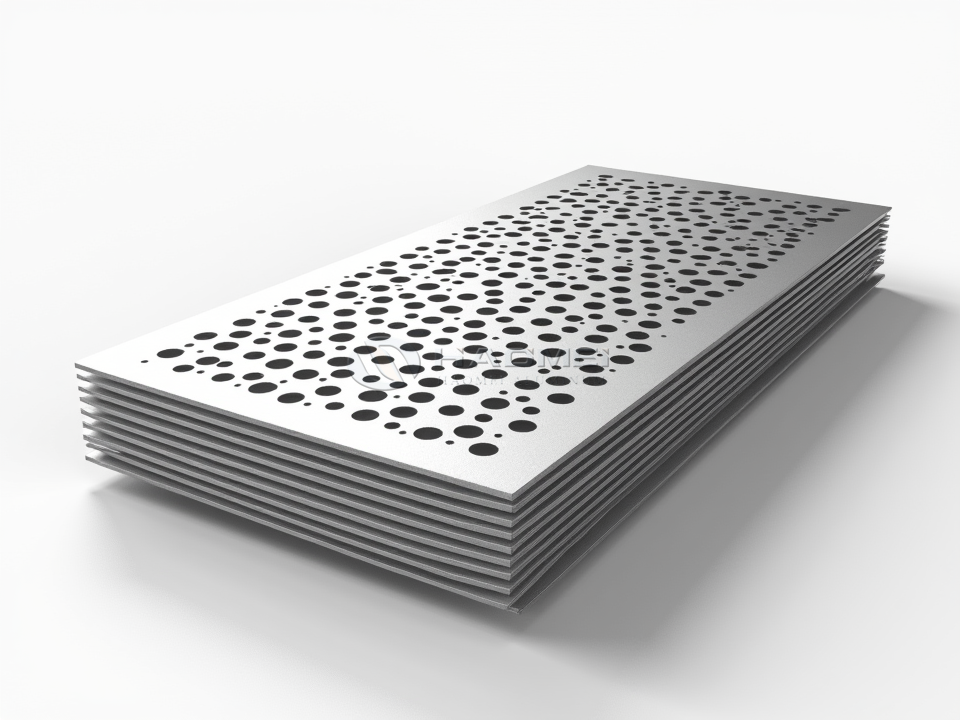
The perforation arrangement has a direct effect on airflow, visibility, acoustic response, panel weight, and structural capacity. Round holes on staggered centers are widely used because they provide a high open area with balanced visual distribution. Slotted holes can create a directional appearance and are useful where elongated ventilation paths are desired. Square and hexagonal holes provide stronger graphic character for retail, public-space, and facade work.
| Hole Pattern | Visual Effect | Functional Advantage | Common Open Area |
|---|---|---|---|
| Round, staggered | Soft and uniform | Efficient airflow and balanced strength | 20%-55% |
| Round, straight | Ordered grid | Simple alignment with architectural modules | 15%-45% |
| Slotted | Linear and contemporary | Directional ventilation and drainage | 20%-60% |
| Square | Geometric and bold | Strong visual identity | 15%-45% |
| Hexagonal | Technical and cellular | High transparency with decorative appeal | 25%-55% |
For acoustic installations, perforations are generally paired with black acoustic fleece and mineral wool or glass wool behind the panel. The aluminum face remains durable and easy to clean, while the backing assembly captures sound energy passing through the openings.
Finishes, Fabrication, and Installation Notes
Powder coating is suitable for many interior and exterior applications and offers a broad range of colors and textures. PVDF coating is commonly chosen for demanding facade exposure due to its long-term color and weathering performance. Anodized finishes retain a metallic appearance and improve surface hardness, though color consistency should be reviewed across large panel areas.
Fabrication can include cutting, bending, folding, corner notching, riveting, welding, framing, and concealed fixing preparation. During installation, allow for thermal movement, particularly on long exterior panels exposed to direct sunlight. Use compatible fasteners and isolation materials where aluminum contacts dissimilar metals, helping prevent galvanic corrosion.
| Installation Consideration | Practical Guidance |
|---|---|
| Support spacing | Confirm from panel geometry, wind load, and required deflection limit |
| Thermal expansion | Provide slotted fixing points or movement joints where required |
| Edge safety | Use folded, hemmed, or framed edges for exposed pedestrian areas |
| Coating protection | Keep protective film in place during fabrication, then remove promptly after installation |
| Cleaning | Use water and mild neutral detergent; avoid abrasive pads and strong alkaline cleaners |
| Drainage | Maintain clear paths so water does not collect in corrugation valleys |
Selecting the Right Panel
A successful corrugated perforated aluminum sheet begins with the service environment and intended function. Specify alloy and coating for corrosion exposure, choose thickness and corrugation depth for span and wind conditions, then set hole pattern and open area for airflow, privacy, or acoustic goals. Providing drawings, panel dimensions, finish color, perforation details, and installation conditions enables accurate production planning and a more dependable final result.
Corrugated perforated aluminum sheet delivers a practical blend of structural efficiency, ventilation, and architectural expression. Whether used as a shaded facade skin, a sound-managing ceiling surface, or a durable industrial guard, it provides a clean metal solution with adaptable performance.